JSON.stringify in V8 Now Twice as Fast
URGENT – The V8 JavaScript engine has received a major performance upgrade: JSON.stringify is now more than twice as fast as before. This optimization directly accelerates data serialization for network requests, localStorage saves, and countless other web operations.
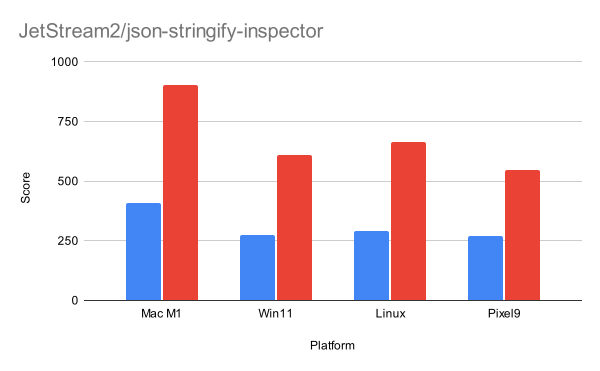
"This is a game-changer for web performance," said Dr. Sarah Chen, lead performance engineer at the V8 team. "We've essentially rebuilt the core serializer to avoid expensive checks and use specialized code paths." The improvement is the result of months of engineering work focused on eliminating side effects and optimizing string handling.
Side-Effect-Free Fast Path
The cornerstone of the speed boost is a new fast path that activates when serialization triggers no side effects. Side effects include user-defined code execution or garbage collection cycles. By guaranteeing a clean traversal, V8 bypasses the general-purpose serializer's defensive logic.
"We built an iterative serializer instead of the recursive one," Dr. Chen explained. "This eliminates stack overflow checks and allows much deeper nesting without performance penalties." The result is a streamlined process for typical plain-object serialization.
Specialized String Handling
Strings in V8 can be stored as one-byte (ASCII) or two-byte (Unicode) representations. The new system compiles two dedicated versions of the serializer – one for each string type. This avoids constant type branching and boosts speed further.
"Mixed encodings are handled efficiently," noted Dr. Chen. "We inspect each string's instance type early. If it's a simple one-byte or two-byte string, the fast path applies. Complex types like ConsString fall back to the slow path to avoid triggering GC." This templatized approach slightly increases binary size but delivers significant performance gains.
Background
JSON.stringify is a core JavaScript function that converts objects to JSON strings. It's used everywhere – from APIs to local storage. Even small improvements can have a huge impact because serialization is such a common operation.
V8 is Google's high-performance JavaScript engine, used in Chrome, Node.js, and many other environments. Previous optimizations focused on general case handling; this update specifically targets the most frequent use cases where objects are pure data without side effects.
What This Means
For developers, faster JSON.stringify translates to quicker page loads, more responsive apps, and smoother user experiences. Deeply nested objects can now be serialized with fewer stack limitations. The performance uplift is most noticeable in frameworks that rely heavily on serialization, such as React (during server-side rendering) or data-intensive Node.js applications.
"Users will see faster interactions without any code changes," said Dr. Chen. "Just upgrade your browser or Node.js version." The optimization is already rolling out with recent V8 builds and will be included in Chrome 124 and Node.js 22. As adoption spreads, the web becomes noticeably faster.
For more technical details, see the original V8 blog post. This update represents a rare dual improvement: speed and depth capacity – a win for everyone.